How to play Em6 on guitar
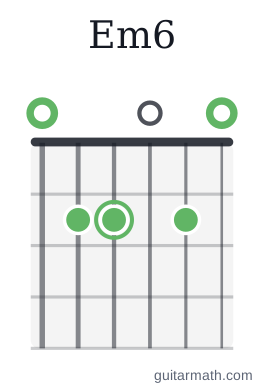
The easiest way to play Em6 is open Em6: 0 2 2 0 2 0, listed from the low E string to the high E string. Play the low E string open; 2nd fret on the A string; 2nd fret on the D string; play the G string open; 2nd fret on the B string; play the high E string open.
An x means don't play that string, and 0 means play it open. Strum only the strings that are part of the shape.
Em6 chord shapes up the neck
Every shape below plays the notes of Em6 (E, G, B and C#), just arranged differently on the neck. Shapes named after an open chord (E-shape, A-shape, Dm-shape and so on) are that open chord moved up the neck, the idea behind the CAGED system. To play Em6 higher up the neck, move from open Em6 to the Cm-shape at fret 5, the Am-shape at fret 7, the Gm-shape at fret 9 and the shape with its root on the 6th string at fret 12. Higher shapes sound brighter and thinner, and the shapes near the nut sound fuller.
| Shape | Frets (low E to high E) | Root on | Barre | Best for |
|---|---|---|---|---|
| Open Em6 | 0 2 2 0 2 0 | 6th (low E) | No | Beginners and strumming |
| Cm-shape, fret 5 | x 7 5 6 5 7 | 5th (A) | Partial barre (3 strings) | Moving up the neck |
| Am-shape, fret 7 | x 7 9 9 8 9 | 5th (A) | No | No-barre option |
| Gm-shape, fret 9 | 12 10 9 9 12 9 | 6th (low E) | Partial barre (4 strings) | Bright high voicing |
| Root on 6th string, fret 12 | 12 14 11 12 x x | 6th (low E) | No | Bright high voicing |
A partial barre is one finger pressing two or three strings at the same fret. A full barre presses five or six strings, which takes more strength.
Shape by shape
- Open Em6 (0 2 2 0 2 0): The standard open shape most players learn first. No barre needed.
- Cm-shape, fret 5 (x 7 5 6 5 7): A small partial barre, with the root on the A string. Easy to move to other frets.
- Am-shape, fret 7 (x 7 9 9 8 9): No barre needed, with the root on the A string. Easy to move to other frets.
- Gm-shape, fret 9 (12 10 9 9 12 9): A small partial barre, with the root on the low E string. Sits high on the neck for a brighter sound.
- Root on 6th string, fret 12 (12 14 11 12 x x): No barre needed, with the root on the low E string. Sits high on the neck for a brighter sound.
Movable Em6 shapes
Any shape with no open strings is movable: slide it up or down and it plays a different minor 6th chord. The note on the 6th string (low E) names the chord. Here is the Gm-shape at fret 9 moved to every root, so one shape gives you all 12 minor 6th chords.
| Chord | Root fret | Frets (low E to high E) |
|---|---|---|
| Cm6 | 8 | 8 6 5 5 8 5 |
| C#m6 | 9 | 9 7 6 6 9 6 |
| Dm6 | 10 | 10 8 7 7 10 7 |
| Ebm6 | 11 | 11 9 8 8 11 8 |
| Em6 | 12 | 12 10 9 9 12 9 |
| Fm6 | 13 | 13 11 10 10 13 10 |
| F#m6 | 14 | 14 12 11 11 14 11 |
| Gm6 | 15 | 15 13 12 12 15 12 |
| Abm6 | 4 | 4 2 1 1 4 1 |
| Am6 | 5 | 5 3 2 2 5 2 |
| Bbm6 | 6 | 6 4 3 3 6 3 |
| Bm6 | 7 | 7 5 4 4 7 4 |
What notes are in Em6?
Em6 is a minor sixth chord. Its notes are E, G, B and C#: the root, minor 3rd, perfect 5th and major 6th.
| Note | Interval | Formula |
|---|---|---|
| E | root | 1 |
| G | minor 3rd | b3 |
| B | perfect 5th | 5 |
| C# | major 6th | 6 |
What Em6 sounds like
Bittersweet and mysterious. A minor 6th adds a bright major sixth to a minor chord, a classic sound in jazz and film music.
Chord progressions with Em6
| Progression | Key | Chords |
|---|---|---|
| Minor line cliché | E minor | Em Em(maj7) Em7 Em6 |
More E chords
E, Em, E7, Emaj7, Em7, Esus2, Esus4, Eadd9, E5, E6, E9, Em9, Emaj9, Edim, Edim7, Eaug, Em7b5, E7sus4. See every chord on the guitar chord chart.
Common questions
What are the different ways to play Em6?
How do you play Em6 on guitar?
What is the easiest way to play Em6?
How do you play Em6 higher up the neck?
What notes are in the Em6 chord?
What does a minor 6th chord sound like?
Last updated November 15, 2026.