How to play C#aug on guitar
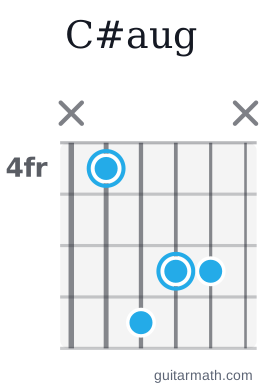
The easiest way to play C#aug is the A-shape at fret 4: x 4 7 6 6 x, listed from the low E string to the high E string. Mute the low E string; 4th fret on the A string; 7th fret on the D string; 6th fret on the G string; 6th fret on the B string; mute the high E string.
An x means don't play that string, and 0 means play it open. Strum only the strings that are part of the shape.
C#aug chord shapes up the neck
Every shape below plays the notes of C#aug (C#, E# and G##), just arranged differently on the neck. Shapes named after an open chord (E-shape, A-shape, Dm-shape and so on) are that open chord moved up the neck, the idea behind the CAGED system. To play C#aug higher up the neck, move from the A-shape at fret 4 to the shape with its root on the 5th string at fret 4, the G-shape at fret 6, the E-shape at fret 9 and the D-shape at fret 11. Higher shapes sound brighter and thinner, and the shapes near the nut sound fuller.
| Shape | Frets (low E to high E) | Root on | Barre | Best for |
|---|---|---|---|---|
| A-shape, fret 4 | x 4 7 6 6 x | 5th (A) | No | No-barre option |
| Root on 5th string, fret 4 | x 4 3 2 2 5 | 5th (A) | Partial barre (2 strings) | Moving up the neck |
| G-shape, fret 6 | 9 8 7 6 6 x | 6th (low E) | Partial barre (2 strings) | Moving up the neck |
| E-shape, fret 9 | x x 11 10 10 9 | 4th (D) | No | Bright high voicing |
| D-shape, fret 11 | x x 11 14 14 13 | 4th (D) | No | Bright high voicing |
A partial barre is one finger pressing two or three strings at the same fret. A full barre presses five or six strings, which takes more strength.
Shape by shape
- A-shape, fret 4 (x 4 7 6 6 x): No barre needed, with the root on the A string. Easy to move to other frets.
- Root on 5th string, fret 4 (x 4 3 2 2 5): A small partial barre, with the root on the A string. Easy to move to other frets.
- G-shape, fret 6 (9 8 7 6 6 x): A small partial barre, with the root on the low E string. Easy to move to other frets.
- E-shape, fret 9 (x x 11 10 10 9): Only the top four strings, so it sounds lighter and brighter than a full barre. Sits high on the neck, nice for a second guitar part.
- D-shape, fret 11 (x x 11 14 14 13): Only the top four strings, so it sounds lighter and brighter than a full barre. Sits high on the neck, nice for a second guitar part.
Movable C#aug shapes
Any shape with no open strings is movable: slide it up or down and it plays a different augmented chord. The note on the 6th string (low E) names the chord. Here is the G-shape at fret 6 moved to every root, so one shape gives you all 12 augmented chords.
| Chord | Root fret | Frets (low E to high E) |
|---|---|---|
| Caug | 8 | 8 7 6 5 5 x |
| C#aug | 9 | 9 8 7 6 6 x |
| Daug | 10 | 10 9 8 7 7 x |
| Ebaug | 11 | 11 10 9 8 8 x |
| Eaug | 12 | 12 11 10 9 9 x |
| Faug | 13 | 13 12 11 10 10 x |
| F#aug | 14 | 14 13 12 11 11 x |
| Gaug | 15 | 15 14 13 12 12 x |
| Abaug | 4 | 4 3 2 1 1 x |
| Aaug | 5 | 5 4 3 2 2 x |
| Bbaug | 6 | 6 5 4 3 3 x |
| Baug | 7 | 7 6 5 4 4 x |
What notes are in C#aug?
C#aug is an augmented triad. Its notes are C#, E# and G##: the root, major 3rd and augmented 5th. C#aug and Dbaug are the same chord: the same pitches, spelled differently. E# is the same pitch as F: the name just keeps one note per letter. Spelled strictly by letter it needs a double sharp: G## is the same pitch as A.
| Note | Interval | Formula |
|---|---|---|
| C# | root | 1 |
| E# | major 3rd | 3 |
| G## | augmented 5th | #5 |
What C#aug sounds like
Dreamlike and unresolved. Every note is a major third apart, so the same shape repeats every four frets with the same notes.
More C# chords
C#, C#m, C#7, C#maj7, C#m7, C#sus2, C#sus4, C#add9, C#5, C#6, C#m6, C#9, C#m9, C#maj9, C#dim, C#dim7, C#m7b5, C#7sus4. See every chord on the guitar chord chart.
Common questions
What are the different ways to play C#aug?
How do you play C#aug on guitar?
What is the easiest way to play C#aug?
How do you play C#aug higher up the neck?
What notes are in the C#aug chord?
What does an augmented chord sound like?
Is C#aug the same as Dbaug?
Last updated November 15, 2026.